
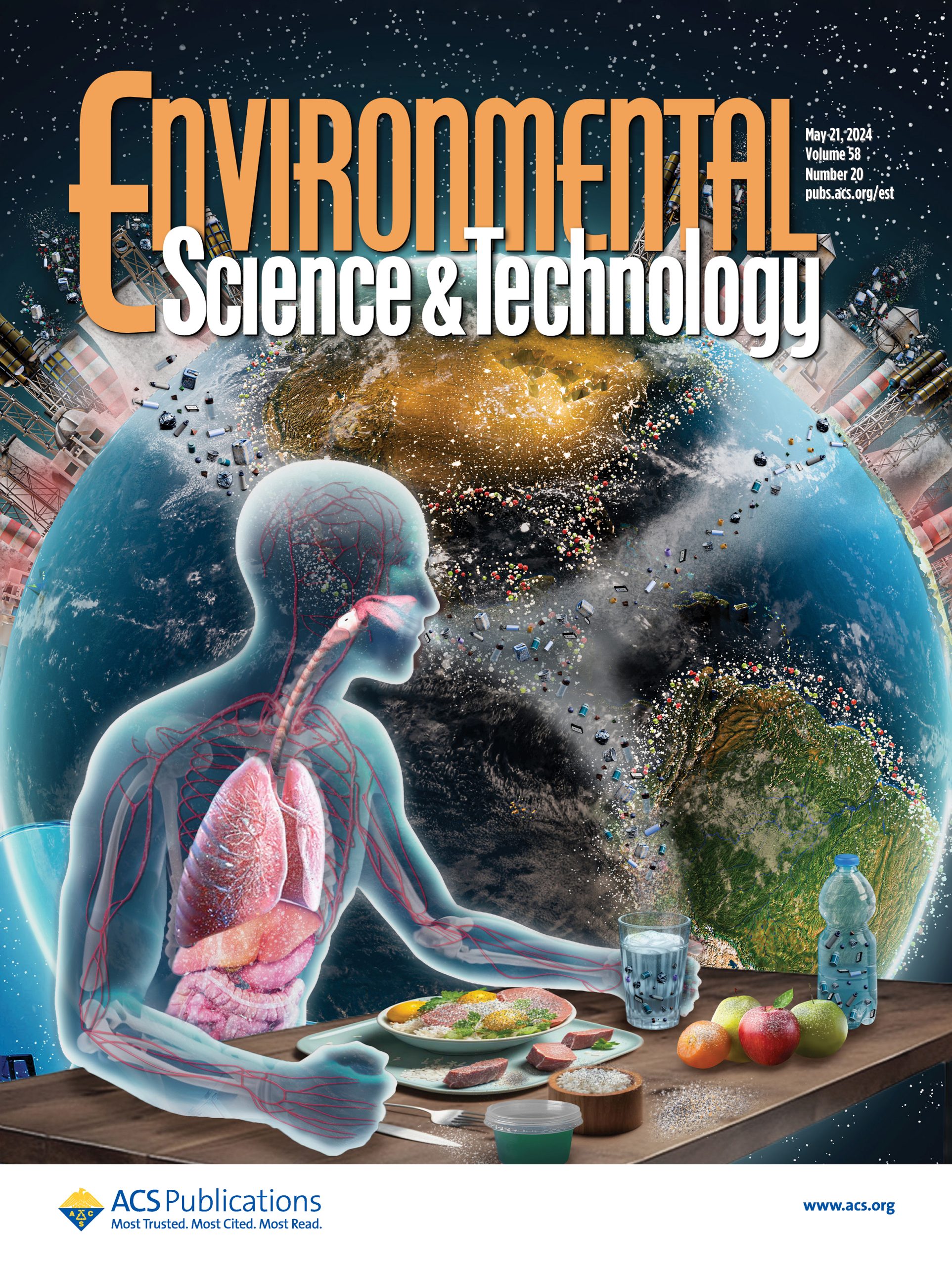
Microplastics are a pervasive environmental and public health challenge, affecting global food systems, atmospheric pathways, and human exposure. Research from the PEESE group applies artificial intelligence (AI) and systems-level modeling to address this challenge, spanning work from quantifying human exposure to developing AI-enabled approaches that may support future mitigation strategies.
Global Human Exposure to Microplastics
PEESE’s publication, “Microplastic Human Dietary Uptake from 1990 to 2018 Grew across 109 Major Developing and Industrialized Countries but Can Be Halved by Plastic Debris Removal,” featured on the cover of the May 2024 issue of Environmental Science & Technology, provides one of the most comprehensive global assessments of human microplastic exposure to date. By identifying regional consumption patterns and evaluating scalable intervention strategies, the study contributes to global efforts to mitigate the impacts of microplastic pollution. The work has received broad international media attention, including coverage by Cornell Chronicle, Daily Mail, The Star, and Newsweek.
AI-Enabled Microplastics Characterization
Beyond exposure assessment, PEESE researchers are advancing AI-driven methods for characterizing microplastics, addressing their inherent heterogeneity and complexity. Recent work published in Science Advances demonstrates how microplastics can self-organize at liquid crystal-water interfaces into distinct interfacial patterns that can be accurately recognized using computer vision. Accurate characterization at these scales is essential for linking particle properties to environmental fate and human exposure, particularly in complex and environmentally relevant samples.
AI-Driven Peptide Design for Microplastics Capture

Complementing exposure assessment and AI-based characterization, PEESE is advancing AI-driven molecular design approaches to explore future strategies for microplastic capture. In a complementary Science Advances study focused on peptide design, “Designing microplastic-binding peptides with a variational quantum circuit–based hybrid quantum–classical approach,” we demonstrated how quantum computing-enabled generative models can be used to discover peptide sequences with strong binding affinity for common plastics.
Building on this foundation, PEESE further developed machine-learning frameworks for peptide design in a Chemical Science paper featured as a front-cover article. This study introduced biodegradable peptides capable of either binding multiple plastic types or selectively targeting specific polymers.
Related studies further extend this peptide-design effort by integrating advanced artificial intelligence and computational modeling approaches. One study applies a protein language model-guided generative framework to design microplastic-binding peptides with enhanced binding performance across heterogeneous plastic mixtures. Another study published in PNAS Nexus combines quantum computing with deep reinforcement learning to discover and optimize plastic-binding peptides through a hybrid quantum–classical workflow. These efforts illustrate how AI-enabled molecular design can support future technologies for microplastic detection, separation, and capture across heterogeneous plastic mixtures.
PEESE’s research reflects an end-to-end, AI-enabled perspective on microplastics, beginning with global human exposure assessment, advancing through AI-based characterization, and extending toward the design of molecular tools for potential mitigation. By bridging systems engineering, environmental science, AI, and molecular design, this body of work contributes new scientific foundations for understanding and addressing microplastic pollution at scale.